
How Long Before Marketing Works? Set a Threshold, Not a Deadline
Google’s real guidance is “a few weeks,” not four months to a year. Here’s how long each channel actually needs, and what to check at 30, 60, and 90 days.
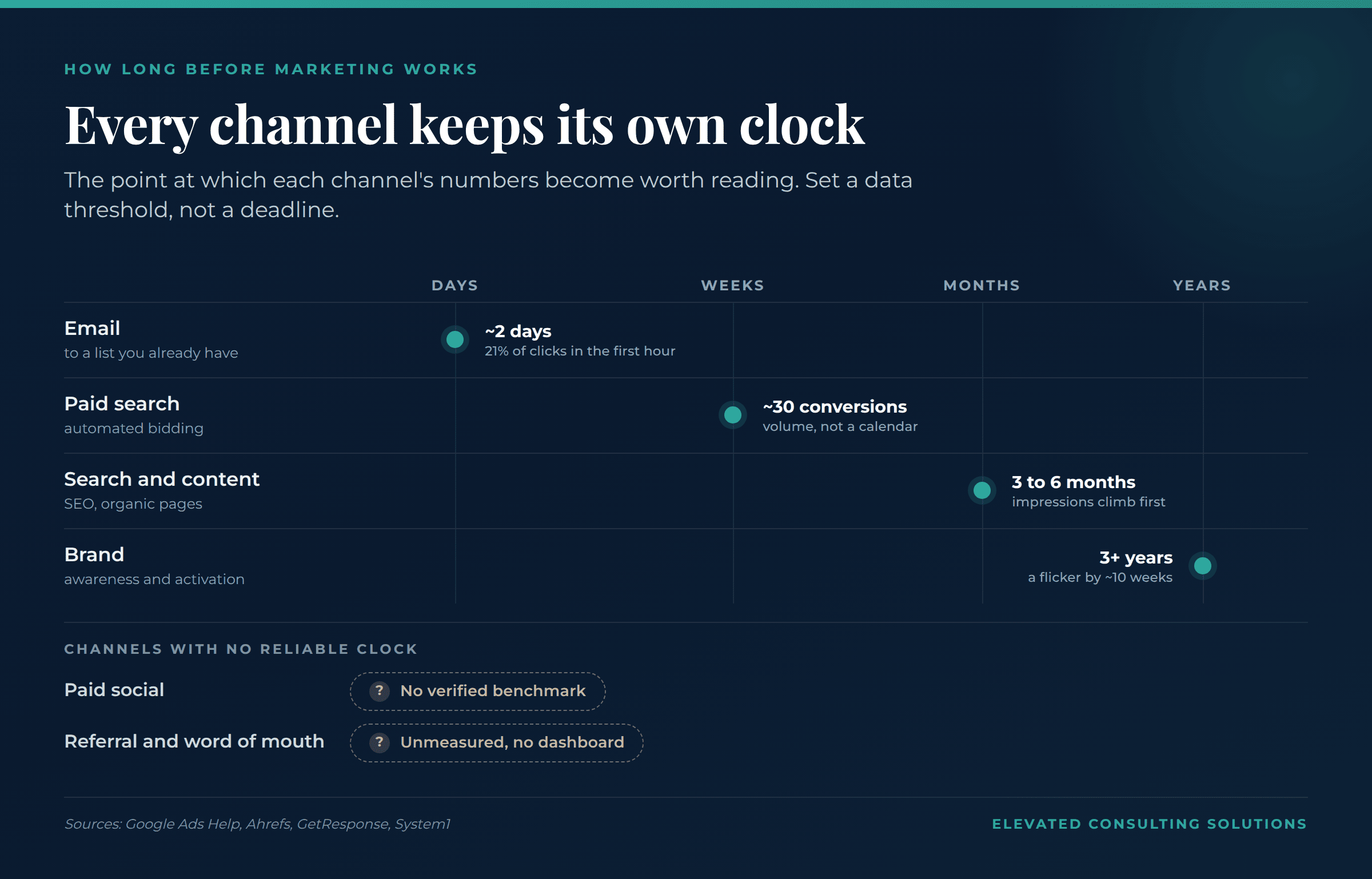
The answer isn’t simple and can range from weeks to months, depending on the type of marketing you’re talking about. An email to a customer list you already have works in about two days. A paid ad can’t be judged until you’ve collected roughly thirty conversions, no matter how long that takes. Search and content are genuinely slow. And at 30 days, you check whether it’s working at all, not whether it has paid off. And paying off is rarely quick. So the question of how long before marketing works usually arrives from a client just a few weeks into most campaigns: “I know it’s too early to expect results, but I am not seeing any traction.”
If there’s one piece of advice I’d give a new or expanding business owner about tracking your marketing, it’s this. Don’t set a deadline in months. Set a data threshold, decide which you expect to hit first, and write both down before you start. It takes time. Marketing isn’t the frills and fun most people assume. It’s strategy, planning, pivoting, and tracking. A month may not tell you much, but it can be enough to help you fine-tune your foundation.
The most-quoted timeline in marketing is a 2017 video about hiring
You’ll see this statement everywhere: Google says it takes four months to a year to see results from search.
It’s worth knowing where that came from. It’s a remark by Maile Ohye of Google in a video about how to hire an SEO, reported in February 2017. It’s nine years old. It advised engaging a consultant, not stating how long ranking takes. And it’s no longer on the Google page it’s usually attributed to.
Google’s current published wording is much shorter and vaguer. The SEO Starter Guide says some changes might take effect in a few hours, others could take several months, and advises waiting “a few weeks” before assessing whether your work helped.
A few weeks. Not four months to a year.
What the research actually shows
The other figure you’ll see quoted is that SEO takes three to six months.
That’s real, and it’s a poll Ahrefs ran on LinkedIn and X, not a study. It asked marketers for their impressions. It was published in 2022, and its poll responses predate AI Overviews entirely. The article concludes that there’s no definitive time frame.
The more useful number comes from Ahrefs actually measuring instead of asking. Across a million random URLs, only 1.74% of newly published pages reach the top ten within a year.
Then the finding that cuts against everything else: of the pages that did reach the top ten, 40% got there within a month.
Read those together, and the picture changes. Most new pages never rank, and the ones that do tend to show early. That doesn’t mean you should quit at four weeks. It means prolonged, total silence is usually information rather than a phase you’re waiting out, and a plan that treats every month as proof of patience is a plan with no way of being wrong.
How long each channel actually needs
Email to a list you already have: about two days. This is the one where patience is simply the wrong instinct. Across 4.4 billion messages GetResponse measured in twenty-four countries, including the Netherlands, 21% of opens and 44% of clicks land in the first hour, and roughly 70% of opens and 85% of clicks arrive within twenty-four hours. There’s no learning phase. If a send hasn’t worked in forty-eight hours, it hasn’t worked, and waiting three months to decide that changes nothing.
Paid search: thirty conversions, not thirty days. Google’s own guidance for evaluating an automated bidding strategy is to measure the last thirty days, including at least thirty conversions. That single line is more useful than any calendar. If you get four conversions a month, you’re seven months from a readable result, and no amount of patience shortens that. Only volume does. Separately, the learning period itself can run up to three weeks, or one to two conversion cycles, and it resets when you make significant edits, which is why constant tinkering keeps a campaign permanently unreadable.
Paid social: nobody can show you the source. The universally quoted rule is fifty optimization events in seven days. I looked for it in Meta’s own documentation. I couldn’t verify it because those help pages aren’t machine-readable, and every page quoting the figure was a third-party blog repeating other third-party blogs.
Search and content: months, with early signals. Three to six months is the working assumption, with the caveats above. Watch for movement in impressions before you watch for traffic.
Referral and word of mouth: unknown, and nobody has measured it. It’s the highest-rated channel among small businesses in LocaliQ’s 2026 trends report, with 83% naming customer referrals their best lead source, up from 65% the year before, though that survey is 87% North American. I could find no credible data on how long it takes to build. Referrals survive impatience precisely because they have no dashboard, so nobody sets a 90-day deadline.
Brand: years, with something visible inside a quarter. Mark Ritson puts brand building on a three-year-plus horizon against roughly twelve months for activation. But System1’s own analysis of high-scoring advertising finds it drives sales in the eight to ten weeks after airing, so even the slow work should produce a flicker inside three months.
What to actually check at 30, 60, and 90 days
Straight answer first: there isn’t an independently validated 30/60/90 framework for small business marketing. I looked for one from an academic body, a trade association, or a platform and found agency content. Anyone can present you with a tidy quarterly milestone chart they built themselves.
What’s defensible is the distinction between a signal and noise at each stage.
| At 30 days, this is signal | At 30 days, this is noise |
|---|---|
| Whether your pages are indexed at all | Ranking position for any single keyword |
| Whether impressions exist, versus zero | Total traffic |
| Crawl errors falling after technical fixes | Conversion rate on fewer than 30 conversions |
| Email opens and clicks, since the channel fully resolves in 48 hours | Engagement on organic social |
| Whether the ad campaign has accumulated any conversions at all | Cost per acquisition on fewer than 30 conversions |
The pattern is that binary questions are answerable early, and rates aren’t. “Is it indexed?” has an answer in week two. “Is our cost per customer improving?” doesn’t have an answer until you have enough customers for the math to hold up.
Pre-commit to two things: a data threshold, such as thirty conversions or two hundred visits to a page, and a date you’ll look at. Decide which you expect to hit first. If the date arrives and the threshold hasn’t, that answers volume rather than the channel, and the fix is usually more spend, more reach, or a narrower target rather than waiting.
If you’re just starting, set the review dates in your calendar before you spend anything. The single most common failure isn’t impatience; it’s never deciding what would count as working.
If you have some traction, stop resetting the clock. Changing a campaign’s targeting, budget, or creative restarts its learning period, and a channel that has been “given three months” across four different configurations has actually been given three weeks, four times.
Frequently asked questions
How long should I give a channel before I quit it?
Long enough to reach the threshold that makes it readable, which for paid search is around thirty conversions and for content is enough published pages to see whether any of them get impressions. If you can’t reach the threshold within your budget, that’s a real answer: the channel isn’t viable at your scale, and it’s worth knowing early.
Is three months enough to judge SEO?
For a verdict, usually not. For a check on whether anything is happening, easily. By three months you should see pages indexed, impressions climbing from zero, and some long-tail phrases appearing. If all three are flat after three months of genuine effort, something is broken rather than slow, and waiting won’t fix it.
My agency says it takes twelve months. Is that reasonable?
It can be for competitive search terms. Ask two questions before you accept it. What will you show me at 30, 60, and 90 days that indicates we’re on track? What would tell us this isn’t working? An agency that can answer both is worth its retainer. One that answers only with “SEO takes time” is describing its billing cycle.
Why do my ads keep going back into the learning phase?
Because you keep editing them. Significant changes to targeting, bidding, or creative restart the learning period, and each restart discards the campaign’s accumulated understanding. Set it, then leave it alone for the full cycle, even when leaving it alone is uncomfortable.
How long before marketing pays for itself?
Longer than it takes to see whether it’s working, and those are two different questions. Early signals tell you a channel is alive. Payback needs enough volume for the math to settle: for paid search, that means clearing your cost per customer across at least thirty conversions; for content, it can mean a quarter or more of published pages earning traffic. Set the payback point as a number, not a date, and judge against that.
Before your next campaign
Write two lines: the threshold that will make the results readable and the date you’ll look. Put the date in the calendar. Then leave the thing alone until one of them arrives.
That’s a small discipline, and it removes the most expensive mistake in marketing: quitting at week three and starting again from nothing.
Knowing when to look is only half of it. Knowing what to look at is the other half, and the five numbers worth checking are in Stop Guessing: How to Tell If Your Marketing Is Working.
Subscribe to get future articles and resources from us as they’re published.
If you’re trying to work out whether to give something another quarter or cut it loose, let’s talk.
The strategy session is 60 minutes and costs €95, and the fee counts in full toward your package if you go on to work with us. Not ready for that? Take the free 5-minute Marketing Growth Audit first.
Sources
Every source below is also linked inline where it is cited in the article.
- Search Engine Roundtable. Google: Give SEOs 4 to 12 Months, February 2017. Reports a video remark by Maile Ohye about hiring an SEO. seroundtable.com
- Google. SEO Starter Guide, Google Search Central. developers.google.com
- Ahrefs. How Long Does SEO Take to Show Results?, August 2022. Based on LinkedIn and X polls, n=3,680. ahrefs.com
- Ahrefs. How Long Does It Take to Rank in Google? And How Old Are Top Ranking Pages?, data collected September to October 2023. One million URLs and 1.3 million keywords: 1.74% of new pages reach the top ten within a year, and 40.82% of those that ranked did so within a month. ahrefs.com
- GetResponse. Email Marketing Benchmarks. 4.4 billion messages sent in 2023 across 24 countries, including the Netherlands, Belgium, and Germany. getresponse.com
- Google Ads Help. About Target CPA bidding. Source of the 30-conversion evaluation guidance. support.google.com
- Google Ads Help. Duration of the learning period for campaigns and what affects it. support.google.com
- LocaliQ. The Big Small Business Marketing Trends Report for 2026. Survey of 300-plus small businesses, 87% United States and Canada. localiq.com
- Marketing Week. Mark Ritson on brand building and short-term sales, February 2023. marketingweek.com
- System1. The Long and Short of It. system1group.com
Leave a Reply