
Where Your Customers Come From: Track It In 4 Easy Steps Without Buying Anything
Attribution software records the last click, not the reason. One question, asked at the right moment, tells you more.
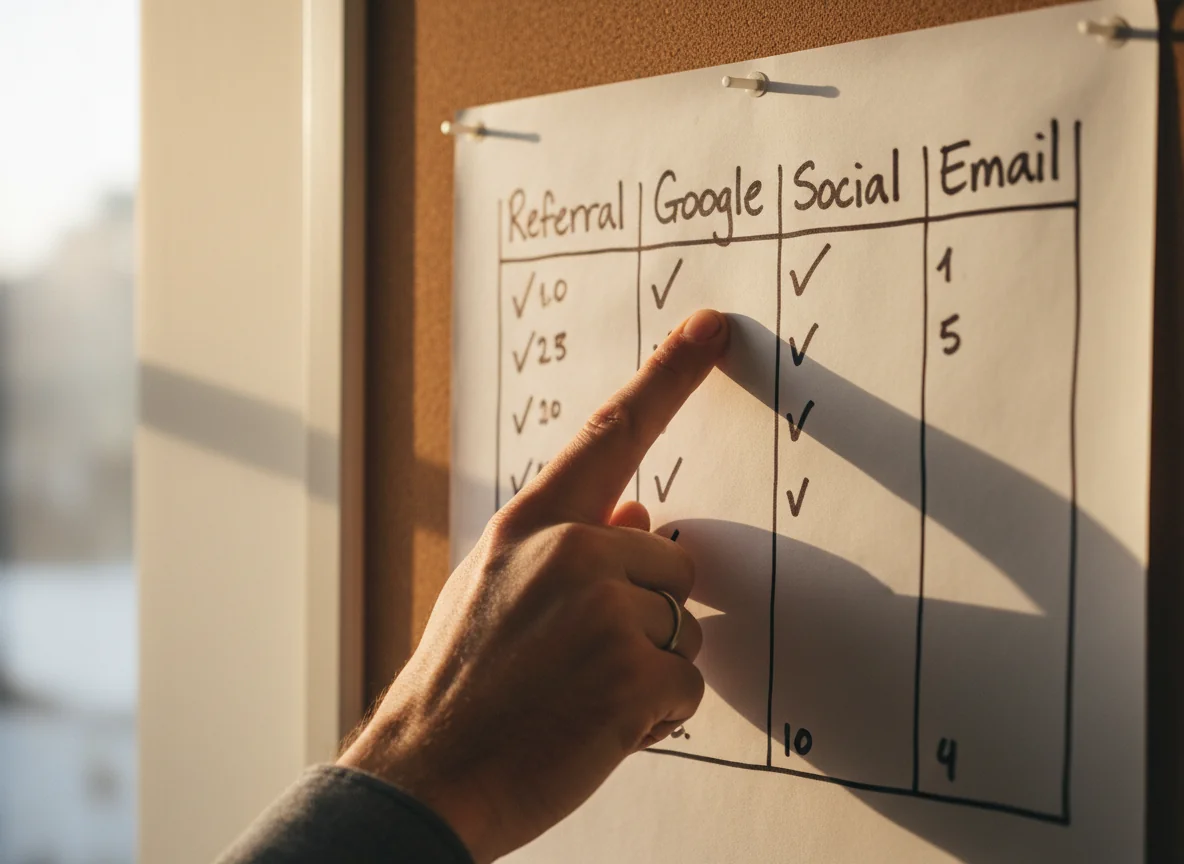
Someone posted this to a marketing forum and got 101 replies: “I have been making a few sales lately but have no idea where they are coming from.”
Almost every reply recommended a piece of software. One person suggested asking the customers.
That one is right, and here’s the whole method before we go further. Ask every new contact where they first heard about you, in an open box, straight after they buy or book. Write the answers down word for word. Sort them into rough categories once a quarter and set that list beside whatever your analytics claims. Where the two disagree, believe the people. At your volume, this costs nothing and tells you more about where your customers come from than a tracking platform would.
The method, in four steps
The whole system is four habits and a notebook. Nothing here needs a subscription, a tag manager, or a developer.
Put the question where they commit
Thank-you page, booking confirmation, or spoken aloud on the first call, while you’re fresh in their mind and they’re well disposed toward you. Never on the contact form, where it adds friction before you’ve earned any.
Use an open box, and ask about the first time
“How did you first hear about us?” That one word settles an ambiguity most businesses never notice: without it, some answer with what made them aware of you and some with what they clicked last. Add a line saying why. “This helps us know which channels are working” reads as human rather than data collection.
Write the answers down verbatim
A notebook is fine. Keep their words rather than your summary of them, because the phrasing is where the useful detail hides.
Sort and compare once a quarter
Group the answers into five or six categories and put that list beside your channel report. The disagreements are the whole point. Keep the wording and the categories identical across the quarter, or you have reset your own comparison.
On step 2, the published advice is contradictory, and nobody acknowledges it. HubSpot recommends multiple choice because it’s faster to analyze; the analytics firm Recast argues against dropdowns, since people pick whatever sits at the top and will choose something wrong before leaving a box blank. Order bias is documented, and free-text bias isn’t. The case for fixed options is analyst convenience, worth nothing at eight inquiries a month. You can read 96 answers a year over a coffee.
Why “direct” isn’t an answer
Open your analytics and a large share of your visitors sit under direct traffic. It reads like a description of a person, someone who typed your address in from memory.
Direct is what the system writes down when nothing told it where the visitor came from. Somebody clicked a link in WhatsApp. Somebody declined your cookie banner. Somebody read about you in a newsletter, thought about it for two weeks, and came back later. All direct.
One marketer on a support forum asked why a contact showed as direct instead of the paid LinkedIn click that brought them in. That person had visited the site once before clicking the ad, so the first visit overwrote the paid one. Working exactly as designed, and useless.
Semrush, in an analysis of more than 50,000 websites across 2025, puts direct at 64.69% of all visits. The largest category in most reports, and it means almost nothing.
That hole isn’t closing either. Third-party cookies aren’t going away: Google abandoned the deprecation plan in 2024 and in October 2025 retired ten Privacy Sandbox technologies including the Attribution Reporting API. In Europe, the binding constraint was never cookies anyway; it’s consent. Refuse the banner and the visit becomes direct traffic.
And AI assistants are a new hole whose size is contested. Semrush finds AI referrals are still only 0.14% of visits, while Graphite, studying the software company n8n, found its tracking crediting AI search with about 1% of conversions against 9% in n8n’s own post-purchase survey. The measured share is tiny, and the real one may be far larger, which is the argument for asking people directly.
What the software misses
A doctor doesn’t begin with a scan. They begin with “what brought you in today?” The patient says the pain got bad on Tuesday, which is true and isn’t the cause. Tuesday is when it became impossible to ignore, and the useful conversation works backward from there.
Attribution software only ever records Tuesday. It captures the last identifiable step before someone acted, frequently a search for your business name, with no way of knowing why they searched it.
The best evidence that this gap is real comes from Refine Labs, an agency that ran both methods side by side for 12 months across 620 conversions, asking every buyer in a mandatory free-text box how they had heard about the firm. Its software credited web search with 78% of first contacts; its customers put it at 12%. What the industry calls dark social, meaning conversations no analytics can see, accounted for 85% of what buyers named. The table below has the rest.
| Measured at | What the software said | What the customers said |
|---|---|---|
| Web search, first contact | 78% of conversions | 12% of conversions |
| Web search, closed business | 79% of conversions | 3% of conversions |
| Dark social | Not measurable | 85% of buyers named it |
| Podcasts | Zero | Highest of any channel |
Read that carefully. One agency, business-to-business, American, with a commercial interest in the dark social story. It’s still the most direct comparison anyone has published.
Where the question fails
Being honest about this is what makes the method usable, so here’s what goes wrong.
People credit the famous nameSomeone hears about you from a friend, searches, sees an ad, and reports the ad, because it’s the recognizable thing. RevenueCat describes a subscription business whose $10,000 campaign was credited with more than 200 conversions by its tracking, yet produced no detectable movement in what customers said. Big platforms gain from this bias. Small referral sources lose.
Only buyers answerYou learn which channels bring customers and nothing about the channels where you are invisible.
Some skip itRecast estimates roughly three in ten when the field is optional, though every response-rate figure available comes from a company selling survey tools. It matters less than it sounds: the method needs a response rate above zero, which is where you are now.
What not to buy yet
Nowhere could I find a statement of how many conversions you need before an attribution model means anything. Several guides push multi-touch modeling without mentioning volume.
So here’s the number nobody gives you. At eight inquiries a month, a multi-touch model splits fractional credit across touchpoints on a sample where one unusual customer moves any channel’s apparent share by more than 12%. That percentage is noise wearing a suit.
The same goes for tooling. One widely recommended platform runs at $100 a month, which, at eight inquiries, is $12.50 spent finding out about each inquiry. You’d learn more by asking.
If you’re just starting, one question and a notebook is the entire system. Add nothing until the notebook stops being enough. If you have some traction, add tracking parameters to your own links, free and useful for the campaigns you control, and keep asking the question for everything else.
Frequently asked questions
What if someone says “Google”?
Someone who says “Google” has told you where they clicked, not where they heard about you. Follow up with what made them search. Many people who say Google, as the data scientist Christopher Penn points out, were told about you by a person and then looked you up, and the search engine takes the credit.
How long before this tells me anything?
About three months. One month gives you anecdotes; a full quarter gives you a shape you can act on, as long as the wording and the categories stay identical throughout.
Should I still use Google Analytics?
Yes, for what it’s good at, which is showing what visitors do on your site once they arrive. Treat its channel report as one witness, not the record. When it disagrees with your customers, they’re describing what happened and the software only what it could see.
My best customers all come from referrals. Is there anything to track?
More than you would think, and it’s the most valuable tracking you can do. Log who referred whom, one line each. Within a year you’ll know the handful of people who send you most of your work, and referral is the one channel almost nobody measures, because it has no dashboard.
How do I track offline sources like flyers, business cards, or word of mouth?
The same question that works online catches offline sources no tool can see: the flyer, the business card, the sign in your window, the friend who recommended you. For anything printed, put a different short link or code on each, so a booking that quotes it tells you which one did the work.
Start on Monday
Ask the next person who contacts you where they first heard about you. Write it in a notebook. Do it again for everyone after that.
In three months you’ll have a plain answer to where your customers come from, in their own words. The surprises in it are usually where the next bit of growth is hiding.
This is the fifth of five numbers that together tell you whether your marketing is working, and the full set is in Stop Guessing: How to Tell If Your Marketing Is Working. The first pairs with this one: how to track qualified leads and the revenue they generate gives you the table these answers slot into, and what a social media audit actually tells you covers the social channels.
Subscribe to get future blogs and resources from us as they’re published.
If your analytics and your customers are telling you different stories and you’d like help working out which to believe, we’ll happily take a look with you.
The strategy session is 60 minutes and costs €95, and the fee counts in full toward your package if you go on to work with us. Not ready for that? Take the free 5-minute Marketing Growth Audit first.
Sources
Every source below is also linked inline where it is cited in the article.
- Semrush. We Analyzed Billions of Web Visits: How AI Is Reshaping Traffic Channels, 27 April 2026. More than 50,000 websites across 17 industries, January to December 2025. Direct 64.69%, AI referrals 0.14%. semrush.com
- Refine Labs. The Attribution Mirage. 620 conversions over 12 months, mandatory free-text self-report compared against software attribution. US business-to-business. refinelabs.com
- RevenueCat. How Did You Hear About Us Surveys, December 2025. revenuecat.com
- Recast. How Did You Hear About Us. Source of the dropdown order-bias argument and the skip-rate estimate. getrecast.com
- Google. Update on Plans for Privacy Sandbox Technologies, 17 October 2025. Ten technologies retired, the Attribution Reporting API among them. privacysandbox.google.com
- Graphite. The n8n Attribution Gap, data December 2025 to April 2026. Single company; response rate not disclosed. graphite.io
- Christopher Penn. The Most Important Question in Attribution Analysis, June 2021. christopherspenn.com
Leave a Reply