
Customer Lifetime Value: The 3:1 Rule Wasn’t Written for Service Companies
The figure that says a customer should be worth three times what it costs to acquire them is based on an 80% gross margin; if you’re selling services, you’re a long way from reaching that figure.
Many business owners are constantly told this figure and probably weren’t informed as to what it represents. The ratio of three to one appears in almost all articles concerning customer lifetime value. It’s always presented as a clear, clean target and never with the qualifying condition that would make it valid.
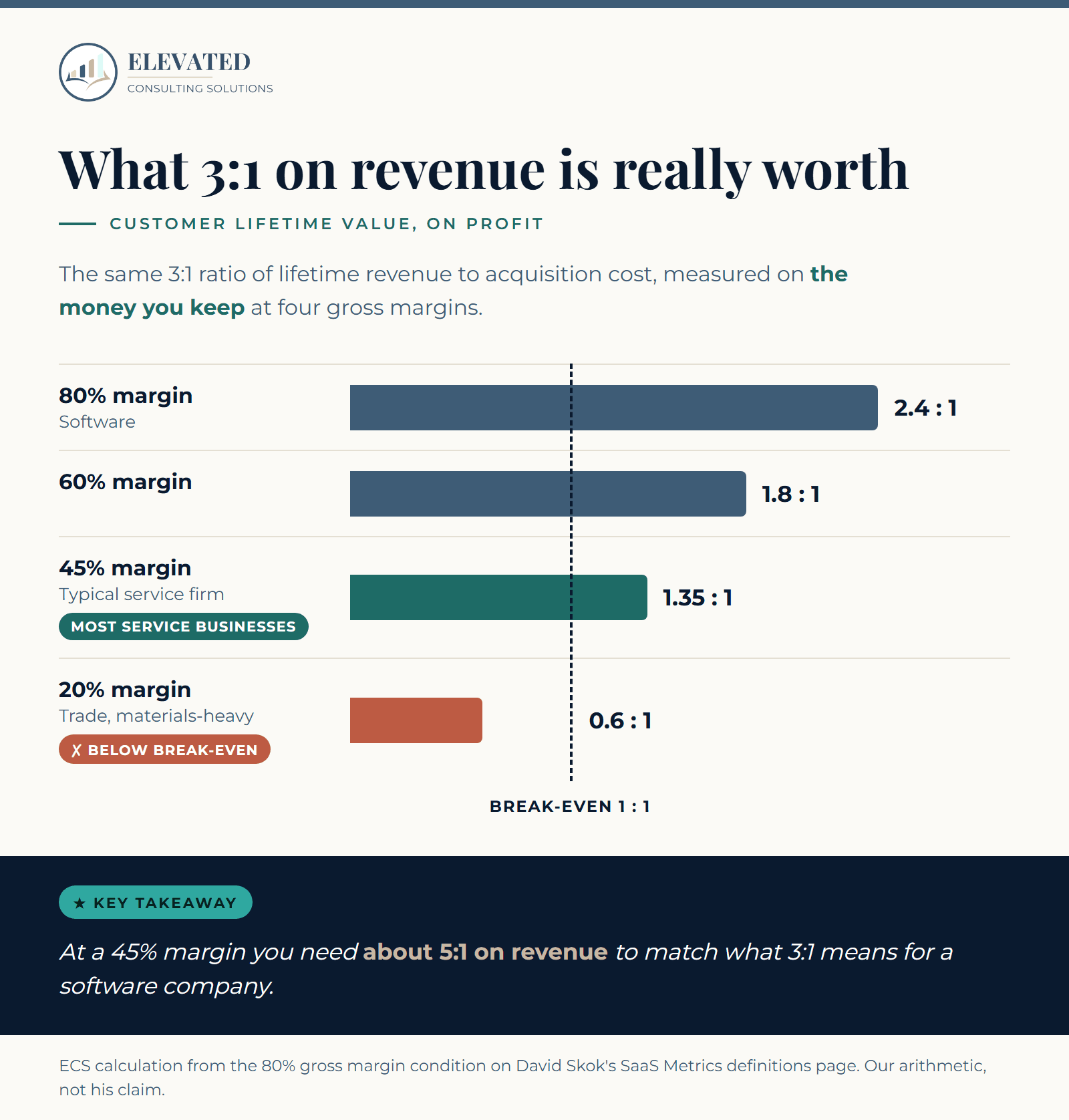
The margin in question is 80%, which works for software companies, not for a service business. Below that point, the rule quietly works against you: a company with a 45% margin and a revenue ratio of 3:1 is really running about 1.4:1 on the money it keeps. Measure it on gross profit against the acquisition cost, and a number that looked healthy is close to break-even.
The brief examines each of the five claims about customer lifetime value that owners most frequently receive, namely the 3:1 figure in question, how it’s to be measured, when it’s worthwhile calculating it, and the retention figures associated with it, and verifies them against their original sources. Only a few of these claims hold up. Most don’t, at least not for service businesses.
Claim: a 3:1 customer is a healthy customer
Mixed evidenceThe rule, an LTV to CAC (LTV:CAC) ratio of 3:1, can be found in David Skok’s well-known article on SaaS Metrics. There he states that the best companies achieve a ratio higher than three, “sometimes as high as 7 or 8”, and refers to the figures as “only guidelines.” That’s reasonable enough. The problem is the condition that he sets, and all the others omit.
On his definitions page, the guideline “assumes you are using the more basic LTV formula, which omits the gross margin adjustment, and that your gross margin is 80% or above.” A gross margin of 80% applies to software, not to a bakery, a builder, a photographer, or a consultancy.
If revenue is three times the amount obtained at an 80% margin, then the money you actually keep is about 2.4 times as much, so a company with a 45% margin that has a revenue ratio of 3:1 is in effect at about 1.4:1. In order to achieve a true 2.4:1 ratio it would have to have a ratio of roughly 5:1. That calculation is ours, based on Skok’s condition; he doesn’t make that claim.
Exhibit: what “3:1” is worth at your margin
| Your gross margin | What “3:1 on revenue” really is, on profit | Revenue ratio needed for a true 2.4:1 |
|---|---|---|
| 80% (software) | 2.4:1 | 3:1 |
| 60% | 1.8:1 | 4:1 |
| 45% (typical service firm) | 1.35:1 | 5.3:1 |
| 20% (trade, materials-heavy) | 0.6:1 | 12:1 |
ECS calculation from the 80% gross margin condition on Skok’s definitions page. Our math, not his claim.
Jacob Becker, who’s a CPA and writes for direct-to-consumer brands, also makes the same calculation: when a value of $240 is compared to a cost of $100, the apparent ratio of 2.4:1 drops to 1.44:1 at a 60% margin.
Your move. Unless you truly run software margins, regard a 3:1 revenue ratio as being about break-even. Calculate your true gross margin and stick to the higher ratio it requires (approximately 5:1 at 45%), and don’t let a seemingly healthy 3:1 ratio lead you to spend more to win customers.
Claim: customer lifetime value is just the revenue a customer brings in
Weak evidenceThe lifetime value of a customer is the total amount of money they spend with you over the entire relationship. Most formulas end there by focusing only on revenue. When creating a future marketing strategy, that figure is the wrong one to use.
Why? It’s your salary. The amount stated in your contract and the amount that actually ends up in your account are different. For example, if a customer spends $3,000 with you over three years and the cost of completing that work is $1,650, then the customer’s worth to your business is $1,350. The $3,000 represents turnover that passes through.
Dan Layfield of Subscription Index gives the practical version of the same point: always use a gross-margin-adjusted lifetime value. A revenue figure measured against the 3:1 benchmark, which already assumes a high margin, is overstated by roughly the inverse of your gross margin.
Your move. Before you compare your lifetime value to any standard, subtract out the cost of delivery. The amount available for marketing is what remains after deducting delivery costs, and this is generally less than you would expect.
Claim: you should calculate this ratio now
Weak evidenceIf you have 40 customers and 18 months of being in operation, the traditional advice is to find comparable companies and discount their numbers.
The better answer is on Skok’s own site. Jared Sleeper wrote that early-stage businesses should wait, since the figures “will only really be meaningful and reliable when you have found a repeatable and scalable growth process.” The deals secured by a founder themselves tell us little about how a hired sales representative would perform, and customers obtained through referrals say nothing about how a paid sales channel will work. You can’t make a prediction of the future based on 18 months’ work.
Your move. If you started your business within the past two years or are still closing every deal yourself, then don’t feel forced to adhere to this ratio. Instead, monitor the payback: make sure a customer’s spending pays back what it cost to win them within about 12 months, then switch back to focusing on lifetime value once you have a consistent method of securing customers.
Claim: lifetime value works even when customers buy once
Weak evidencePeople such as roofers, wedding photographers, and conveyancing solicitors were asked a simple question by Dave Young on a Wizard of Ads roundtable: “If your business is in air conditioning or you’re a roofer, how many times do you usually have to buy a new roof for your house?” Chuck McKay replied it was “probably one purchase.”
The more extended the purchase cycle, the more difficult the CLV calculation becomes, and no formula can overcome this problem. Instead, it’s necessary to change the nature of the products you offer. A business could begin providing maintenance agreements and annual inspections. To transform one-off sales into measurable and more valuable relationships, they could also offer warranties and service plans. The four-figure lifetime values cited on tool suppliers’ websites are assumptions, not actual measurements.
Your move. If customers make only one purchase, then there’s no point in pursuing a lifetime value that doesn’t exist. So either introduce a service plan that encourages a second visit, or keep an eye on referral value, that is, how many new customers each satisfied customer refers to you.
Claim: the retention statistics everyone quotes are solid
Weak evidenceYou’ll probably be quoted two of these statistics by someone selling retention software.
The cost of acquiring a customer is five times greater than that of retaining one. This is considered to be folklore. In an excerpt featured on Ipsos’s website from the book Loyalty Myths, it’s stated to come from the work of the Technical Assistance Research Programs in the late 1980s, although the exact source is “difficult to determine.” Their conclusion is that a retention strategy based completely on this myth is “a recipe for financial disappointment.”
The statement that a 5% improvement in retention leads to a 25 to 95% increase is only half true. According to Bain’s summary of Reichheld and Sasser’s 1990 article in the Harvard Business Review, companies could increase their profits by almost 100% by retaining an additional 5% of their customers. Another independent Bain paper mentions the 25% figure but limits it to the financial services sector. The commonly quoted range isn’t included in either of these sources, and the study in question is 36 years old.
Your move. Don’t buy retention software based on a figure from thirty-six years ago. Although retention might prove beneficial for you, you should make that decision based on your own repeat rate and referrals, not those of someone else.
What to do with this
Before you look at any benchmark, do one calculation: take your last twenty customers, work out how much each of them spent, subtract the cost of delivering the work to them, and then find the average of what’s left. Compare this figure with the amount you spent in order to win them. That average is your real customer lifetime value, and it will be less than the figure you’re currently thinking of, but it’s the one you can actually build a strategy around.
Frequently asked questions
Should I use revenue or profit in a customer lifetime value calculation?
Gross profit, meaning revenue minus what it costs you to deliver the work. So the customer lifetime value formula we’d use is average yearly revenue from a customer, times the years they stay, times your gross margin. Use revenue if you prefer, but then don’t compare the result against the 3:1 rule, because that rule already assumes an 80% margin and you’d be counting margin twice.
How do I calculate customer lifetime value if I’ve only traded a year?
Calculate what you can, label it provisional, and lean on a payback test: how many months of a customer’s spending it takes to recoup what you spent winning them. Under 12 months is comfortable for most small businesses.
How far back should I look?
As far as your records go, up to about five years. Beyond that, your business has changed enough that those old customers describe a different company.
Does a high lifetime value justify spending more to win customers?
In principle, yes, and it’s where businesses get into trouble. The value arrives over years, while acquisition cost is paid this month, so a healthy ratio can still leave you in cash-flow trouble. Check that you can survive the gap first.
My customers are all different sizes. What do I do?
Split them into two or three groups and calculate each separately. A single average across your biggest and smallest jobs is a number you can’t act on.
Not sure your margin assumptions hold up?
Customer lifetime value only means something next to acquisition cost, and both sit inside a set of five numbers that tell you whether your marketing is working. They’re laid out in Stop Guessing: How to Tell If Your Marketing Is Working. For where those customers come from, Are Your Leads Good? How to Track Qualified Leads and the Revenue They Generate covers what counts as one worth having.
Book a strategy session and we’ll work through the numbers with you.
The strategy session is 60 minutes and costs €95, and the fee counts in full toward your package if you go on to work with us. Not ready for that? Take the free 5-minute Marketing Growth Audit first.
Sources
- David Skok. SaaS Metrics 2.0, For Entrepreneurs. Source of the “higher than 3, sometimes 7 or 8” guideline and the “only guidelines” caveat. forentrepreneurs.com
- David Skok. SaaS Metrics 2.0, Detailed Definitions. Source of the 80% gross margin condition, quoted verbatim. forentrepreneurs.com
- Jared Sleeper with David Skok. Why early-stage startups should wait to calculate LTV:CAC. forentrepreneurs.com
- Jacob Becker, CPA, Finaloop. Your DTC LTV:CAC Ratio Is Lying to You, December 24, 2024. finaloop.com
- Dan Layfield, Subscription Index. LTV:CAC Ratio guide. subscriptionindex.com
- Dave Young and Chuck McKay, Wizard of Ads. Is Lifetime Customer Value Still Important? wizardofads.org
- Keiningham, Vavra, Aksoy and Wallard. Loyalty Myths (2005), excerpt hosted by Ipsos. ipsos.com
- Bain & Company. Zero Defections: Quality Comes to Services, summary of Reichheld and Sasser, HBR 1990. bain.com
- Fred Reichheld, Bain & Company. Prescription for cutting costs. Source of the 25% figure, scoped to financial services. bain.com
- Ehrenberg-Bass Institute. Answering critics. marketingscience.info
Every source above is also linked inline at the point where it is used.
Leave a Reply