
How to Calculate Customer Acquisition Cost When You Are the Marketing Department
🔊 Listen to this article
You know how much you spent on advertising last month. $240 out, two customers in, so you paid $120 each. That’s the number that most owners use, and it appears in almost every article.
But it skips the longest line.
Here’s how to calculate customer acquisition costs that stand up to reality: add up everything you spent to win new customers, including tools, agency invoices, and commissions, price your own hours, and divide by the number of new customers who arrived. The honest number is significantly higher than the ad spend figure, and that’s the point. Any single month is noise; look at the direction over six.
Nobody agrees what goes into it
“There are no defined standards for what is, or isn’t, included in the calculation, so inconsistent calculations are common across the industry and even within a single firm,” says Driven Insights, a finance firm working with small businesses. Their solution isn’t a standard: agree on your own definition and make sure everyone knows it.”
Which is a nice way of saying it’s a convention, not a fact.
We read 12 published guides and logged what each one counts. Advertising spend appears in all of them; salaries in most, software in about half, and agency fees in a handful. Two count the owner’s own time, and in both cases the author was an accountant.
There’s more damage from that gap than from any math mistake. Ad spend, commissions, marketing and sales salaries, and the costs of running both are the four parts that the Corporate Finance Institute defines. If you do that for a company that doesn’t have any marketing people, you’ll get zero. Your number goes back to ad spend, and a term meant to stop that has just made it happen.
The cost you aren’t counting
No invoice arrived for your hours, so they felt free. That’s the whole mechanism: the number most owners carry describes a smaller event than the one that happened.
A founder asked a thread on Indie Hackers: “do you count your own time in CAC? And if you did, would the number scare you?” The answer came back in four words.
Once and immediately stopped.
The accountants who do count it are blunt. If you leave the owner’s salary out, the figure “will be artificially low,” which makes your payback look faster than it is.
So set a current rate for your time. Not your dream rate. What you’d pay a competent person, or what you’d have billed a client. Then count the hours: writing posts, editing photographs, answering inquiries, drafting proposals, chasing the proposals you drafted.
What counting properly does to the number
The size of the gap surprises people. An analysis of consumer brands by Eightx reports two valid numbers for the same Meta advertising: $38 to $58 per acquisition as the platform reports it, and $212 to $230 once the channel is fully loaded. Both are correct. The difference is creative production, agency fees, marketing operations salaries and attribution tooling.
Run yours again with your hours in it. It gets worse. What you had before was incomplete, and you were about to budget on it.
How to calculate customer acquisition cost in an hour
Four steps, one spreadsheet, about an hour. Take last month.
List every dollar you spent to win new customers
Advertising, tools, agency invoices, commissions, referral fees, and the discount you gave to land a first deal. If you argued with yourself about whether something belongs, write it in and note why.
Price your own hours and add them
Pick the rate you’d pay someone competent, or would have billed a client. Apply it to the hours you spent marketing and selling, and write it at the top of the sheet so next month matches.
Divide by the customers who actually arrived
So the customer acquisition cost formula is: everything you spent to win customers, your own hours included, divided by the new customers who arrived in the same period. New customers only, not inquiries and not repeat orders. If your sales cycle runs longer than your reporting month, lag the spend: this quarter’s customers against last quarter’s.
Split it by channel, then keep the working
Paid on its own line, blended underneath. The working is what makes next month comparable, which is the entire point.
The calculation
Customer acquisition cost = (all spend to win new customers + your hours × your rate) ÷ new customers acquired
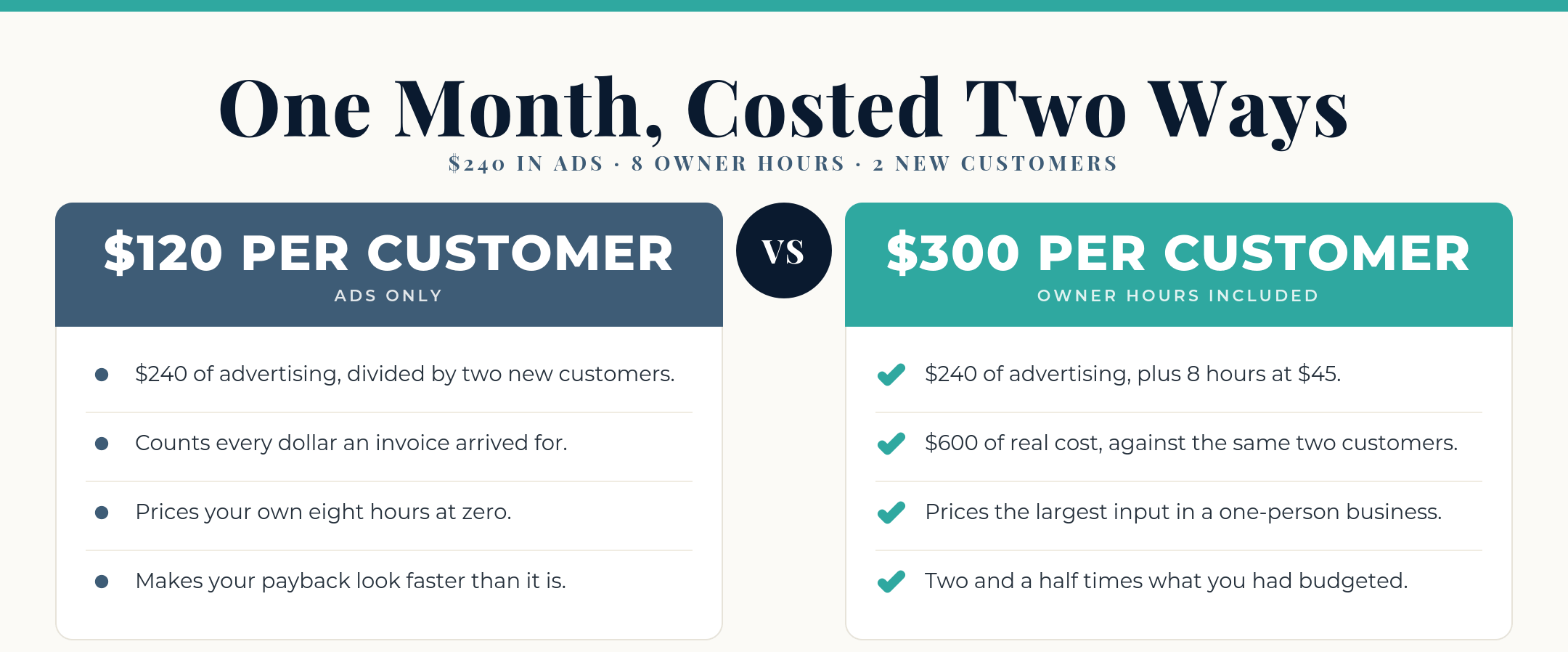
Example: $240 in ads plus 8 hours at $45 gives $600. Two new customers means $300 each, not $120.
Frequently asked questions
Should I include my own time when I don’t pay myself a salary?
Yes, and it’s the single most useful change you can make. Your hours cost you whatever else you’d have done with them, salary or no. Never hold a number that includes your time against one that doesn’t.
What is the difference between cost per lead and cost per customer?
Cost per lead divides by everyone who raised a hand. Acquisition cost divides by the people who paid. Your conversion rate is the gap between them, and confusing the two is how a cheap-looking channel turns out expensive.
My acquisition cost is too high. Should I cut marketing?
Usually not. A high number normally means the wrong channel, the wrong audience, or customers who leave too quickly, and spending less fixes none of those. Set a budget you can afford, then work on what happens to the money.
Does organic content have an acquisition cost at all?
It does, and it’s mostly your hours plus whatever tools you pay for. Content described as free is nearly always labor nobody invoiced.
Do it again in three months
Take last month, run the four steps, and keep the sheet. Do the same in three months and read the direction, not the level. At low volume, one unusual job swings the figure by a third, so trust the trend.
It only means something next to what a customer is worth over time, the next metric in this series. All five are in Stop Guessing: How to Tell If Your Marketing Is Working.
If you’d rather work through your own numbers with us, book your strategy session with us.
The strategy session is 60 minutes and costs €95, and the fee counts in full toward your package if you go on to work with us. Not ready for that? Take the free 5-minute Marketing Growth Audit first.
Sources
Every source below is also linked inline at the point where its finding is used.
- Driven Insights. How to Calculate CAC the Right Way. driveninsights.com
- Corporate Finance Institute. Customer Acquisition Cost. corporatefinanceinstitute.com
- Indie Hackers. What’s your actual cost per customer when you count your own time? Founder discussion thread. indiehackers.com
- Eightx. Average CAC by Channel, 2026. Direct-to-consumer client data from the US, Canada, Australia and the UK. eightx.co
Leave a Reply